

The upright man
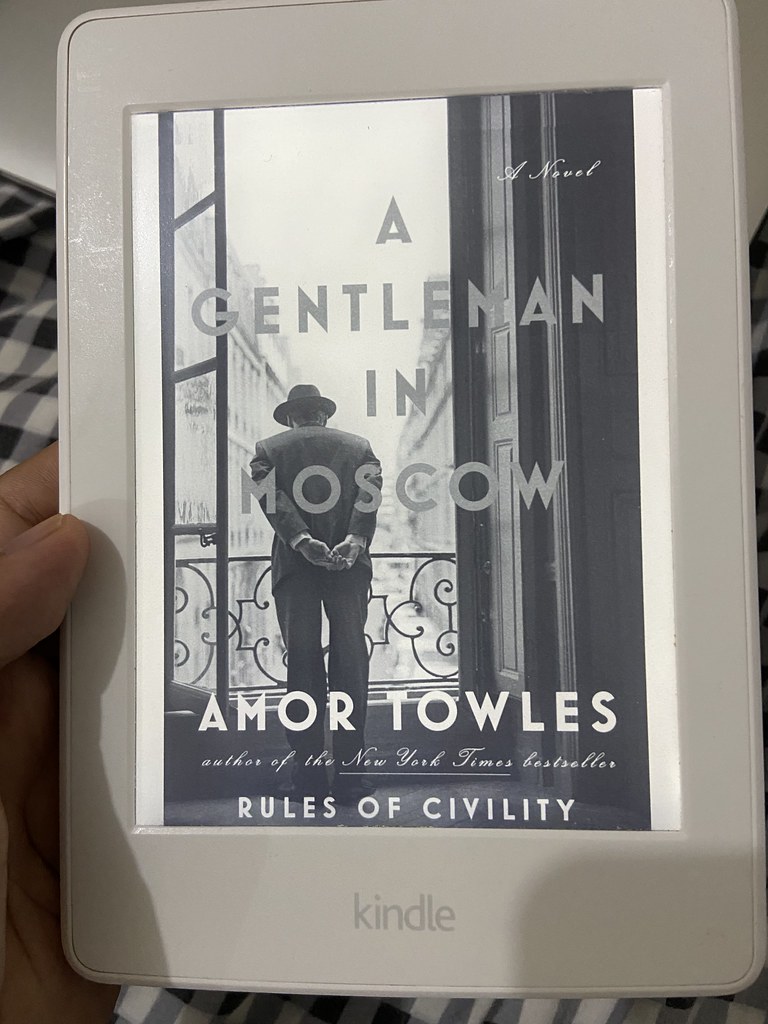
I read Thomas Watson's The Character of an Upright Man. I love Thomas Watson and the Puritans in general. I turn to their writings if this world's air becomes too toxic. Their works offer a glimpse of heaven. There are some of my book highlights.
He also quotes Augustine when he writes that the upright man has peace with his conscience.
The upright man is no adorer of public opinion. (location 45)
This is the question the upright man propounds to himself, "Will this bring glory to God?" He labors still to bring in some revenues into the treasury of heaven. He prefers the glory of God before whatever comes in competition with, or stands in opposition against it. If life is laid in one balance, and God's glory in the other--the glory of God outweighs. (loc. 86)
An upright Christian, though he fails in every duty, yet he makes conscience of every duty. (loc. 110)
The upright Christian does not whirl about, or sinfully prostitute himself to the lusts and desires of men. (loc. 121)
True grace ennobles the heart, dilates the affections, and carries out a man beyond the sphere of his private concernments, making him mind the church's condition as his own. (loc. 175)
He also quotes Augustine when he writes that the upright man has peace with his conscience.
He has peace with his conscience. 1 John 5:10, "He who believes has the witness in himself." his end must needs be peace--who has a smiling God, and a smiling conscience. Augustine calls it, "the paradise of a good conscience." A godly man is in this paradise before he dies.
Adrian Tomine's Scenes from an Impending Marriage

I avoid weddings. I'd rather not go, if I can help it. If I must, I prefer to sit in the periphery where it's easier to leave after a few minutes of meeting and greeting. My friends, the newly married couple, understand me. Because they're too tired to bother anyway, they barely notice that I'm gone.
Adrian Tomine's Scenes from an Impending Marriage: Making Light of Nuptial Narcissism is a hilarious graphic novel that explores what couples have to go through to celebrate a wedding. I had fun reading this, especially the part where the man decides to exclude some friends to spare them the hassle of attending. I am one of those who like to be excluded. If you have problems with your wedding shortlist, feel free to remove me. You're doing me a huge favor. It's hard for me to understand why some people hold grudges against couples who don't invite them.
At the behest of his soon-to-be wife, Adrian Tomine set out to create a wedding favor for their guests that would be funnier and more personal than the typical chocolate bars and picture frames. What started out as a simple illustrated card soon grew into a full-fledged comic book: a collection of short strips chronicling the often absurd process of getting married. A loose, cartoony departure from Tomine’s previous work, Scenes from an Impending Marriage is a sweet-natured, laugh out-loud skewering of the modern marriage process, including hiring a DJ, location scouting, trips to the salon, suit fittings, dance lessons, registering for gifts, and managing familial demands. The most personal and autobiographical work of Tomine’s career, Scenes from an Impending Marriage is a charming, delightful token of love.
Delightful, indeed! I'm such a fan of Adrian Tomine. His New Yorker covers are beautiful. Shortcomings, one of his graphic novels, was engaging.
Manong's lemon yogurt cake

Afternoon merienda, baked by Manong. I don't know why, all of a sudden, both my brothers have taken interest in the kitchen–Sean with his flat bread, Manong with his cakes. I'm useless in that department. Sean jokes that I can't even turn the gas stove on properly (this is partly true, a fear kindled by my experience with a patient whose stove exploded, killing all his family members—surely the exception, rather than the rule). I compensate for it by having good taste in food. "This is too sweet," I would say, like a fake food critic. But this cake had the perfect sweetness. The lemon's tangy citrus flavor made me happy. It had a vibrant fluffiness, best served with Matutum coffee in French press. Kaon ta!


Folding at Home: in search for cures for cancer and other rare diseases
My friend Luther alerted me to Folding at Home. It's a global endeavor where you share a small portion of your device's unused computing power to enable calculations for scientists in search for cures for cancer and other diseases.
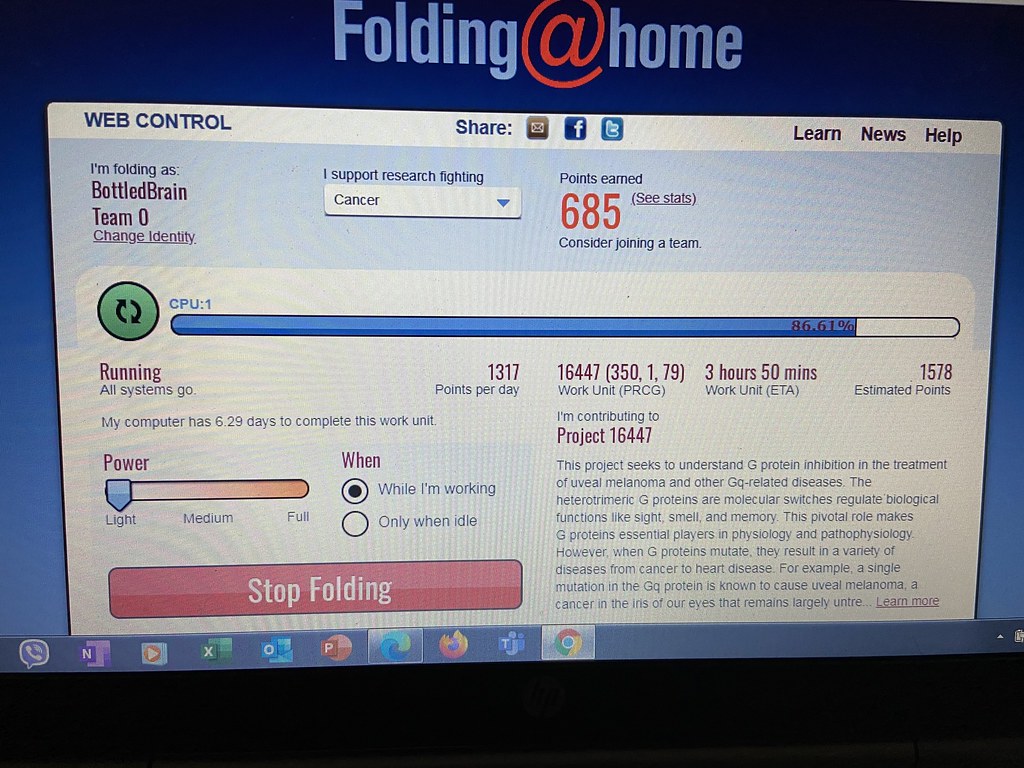
I installed the program two days ago in an old HP laptop that operates on Windows. Since then, I've been involved in a COVID-19 modeling study. Now I'm contributing (albeit passively) to Project 16447.
Uveal melanoma is rare, but I had the privilege of meeting a patient who had this disease. I did not meet her again. I wonder what happened to her.
Protein modeling studies are also close to my heart. In first year med school, my team and I, supervised by Dr. Frank Heralde from the College of Medicine's Department of Biochemistry and Molecular Biology, did protein modeling work on Influenza A(H1N1). We were able to present this work in a major conference in the Netherlands. We collaborated with a modeling program developed by French scientists. I remember that the program required fast computers, so we turned to Marvyn Chan, whose laptop did not lag.
Folding at Home is amusing and amazing, isn't it? If people ask me what I've been doing since the lockdown, I will say, "Finding cures for rare diseases." And I wouldn't be lying.
I installed the program two days ago in an old HP laptop that operates on Windows. Since then, I've been involved in a COVID-19 modeling study. Now I'm contributing (albeit passively) to Project 16447.
This project seeks to understand G protein inhibition in the treatment of uveal melanoma and other Gq-related diseases. The heterotrimeric G proteins are molecular switches regulate biological functions like sight, smell, and memory. This pivotal role makes G proteins essential players in physiology and pathophysiology. However, when G proteins mutate, they result in a variety of diseases from cancer to heart disease. For example, a single mutation in the Gq protein is known to cause uveal melanoma, a cancer in the iris of our eyes that remains largely untreatable short of removing the eye. This is due to an over-active Gq protein. Thus, targeting over-active Gq mutants presents a unique opportunity to treat disease.
Natural product chemistry offers the chance to identify treatments against these difficult to treat targets. A peptide found in Christmas berries, YM-254890 (YM) binds and inhibits Gq, preventing the over-active from resulting cancers. Previous results suggest that YM is even useful in cellular and animal models. However, both the mechanism of Gq inhibition as well as how to optimize YM further (for simplicity, potency, or specificity) remain unknown. This project simulates the heterotrimeric Gq protein bound to YM, to understand its mechanism. Project 16446 simulates the Gq protein by itself, which will help us understand its behavior in the cell.
Uveal melanoma is rare, but I had the privilege of meeting a patient who had this disease. I did not meet her again. I wonder what happened to her.
Protein modeling studies are also close to my heart. In first year med school, my team and I, supervised by Dr. Frank Heralde from the College of Medicine's Department of Biochemistry and Molecular Biology, did protein modeling work on Influenza A(H1N1). We were able to present this work in a major conference in the Netherlands. We collaborated with a modeling program developed by French scientists. I remember that the program required fast computers, so we turned to Marvyn Chan, whose laptop did not lag.
Folding at Home is amusing and amazing, isn't it? If people ask me what I've been doing since the lockdown, I will say, "Finding cures for rare diseases." And I wouldn't be lying.
Language of God: Notes No. 1


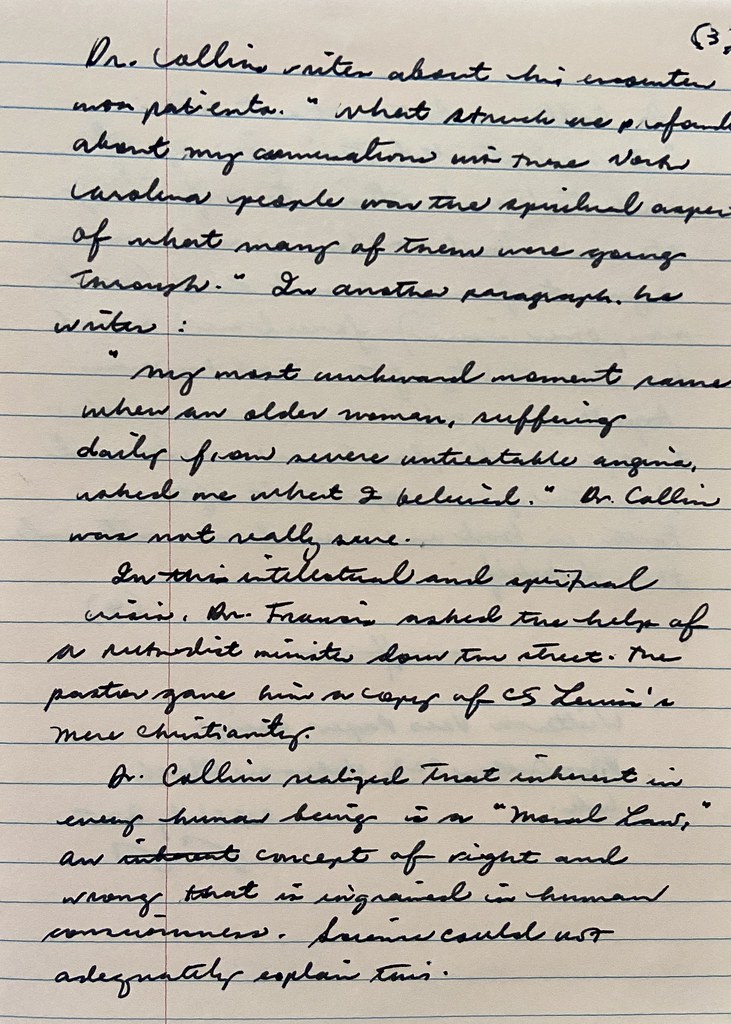

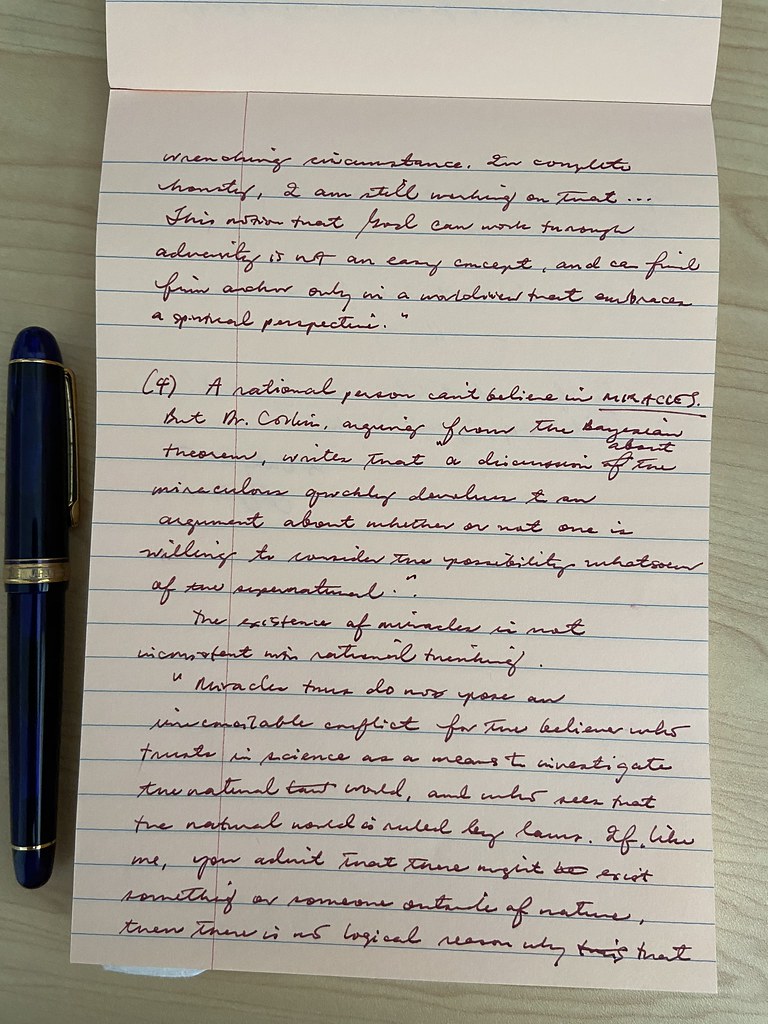
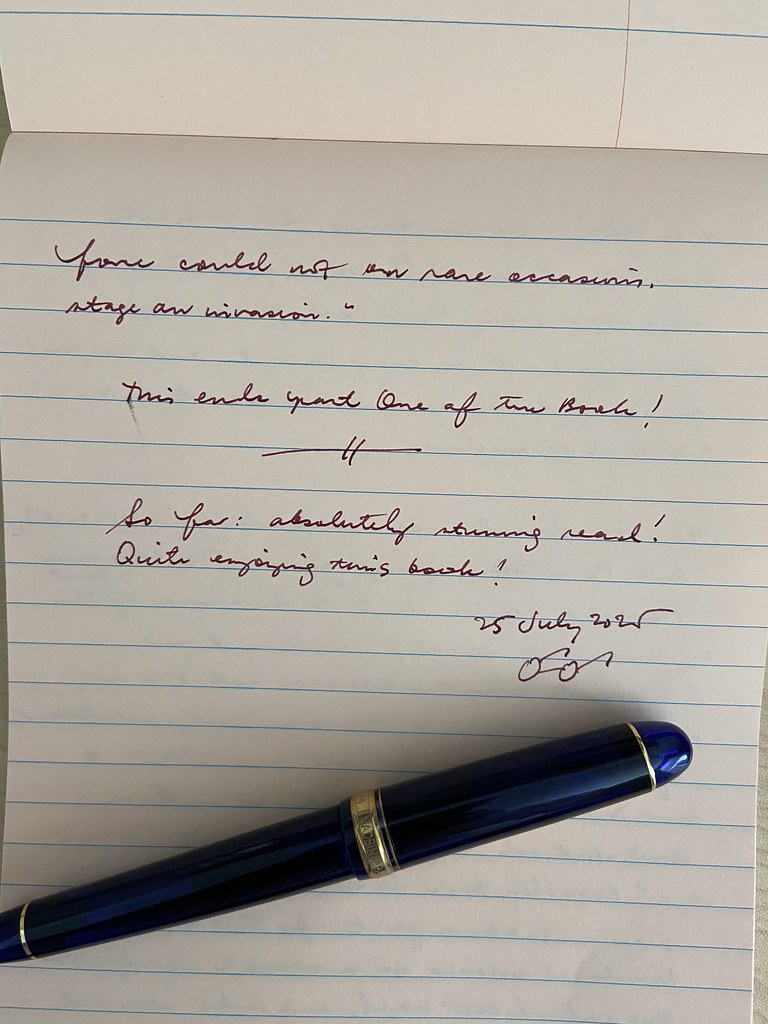
The handwritten notes above make up the initial draft of what should be a coherent essay/review, sort of a personal experiment that seeks to answer the question, "How do I sound if I don't edit myself?" The sentences bleed into each other. I envy people who can put their ideas together without so much as minor erasures.
This is a specimen of my lazy handwriting. I used Pilot Custom 823 (given by my friend Freddie) with Waterman Blank Ink (given by my mentor Dr. Strebel). I must tell you that I write more legibly in medical charts and prescriptions.
I like to resurrect the old habit of writing using pen and paper as I make brief reflections on Dr. Francis Collins's book, "The Language of God."
Chapter One, "From Atheism to Belief," begins with the writer's childhood. He calls his early life "unconventional." He gew up in a farm, with loving yet unusual parents--"a happy mix of pastoral beauty, hard farm work, summer theater, and music, and thrived in it." Dr. Collins writes that "faith was not an important part" of his childhood. He was "vaguely aware" of the concept of God. But even as a child, he liked learning. I believe learning is optimal if the student enjoys the process. Dr. Collins eventually took chemistry as an undergraduate degree, something I can absolutely relate to. It was fascinating to learn that he did not care much for biology, thinking it only involveda lot of memorization.
I liked chemistry first. I can relate to these lines by Dr. Collins:
"Never mind that I knew relatively little about other sciences, this first puppy love seemed life-changing."
In the next paragraph, he begins:
"In contrast, my encounter with biology left me completely cold."
In high school, I didn't do as well in biology. In contrast, I enjoyed chemistry. My brother bought "Chemistry: The Central Science"*, a beautiful textbook that really changed my life.
After graduation, he [Dr. Collins] took a PhD program in physical chemistry at Yale. From being an agnostic, he became an atheist. He got married and, at 22, he went to medical school.
Dr. Collins writes about his encounter with patients.
"What struck me profoundly about my conversations with those North Carolina people was the spiritual aspect of what many of them were going through." In another paragraph he writes:
"My most awkward moment came when an older woman, suffering from severe unstable angina, asked me what I believed." Dr. Collins was not really sure.
In this intellectual and spiritual crisis, Dr. Francis Collins asked the help of a Methodist minister down the street. The pastor gave him a copy of C.S. Lewis's Mere Christianity.
Dr. Collins realized that inherent in every human being is a "Moral Law," a concept of right and wrong that is ingrained in human consciousness. Science could not adequately explain this.
Dr. Collins ends the chapter with:
"I had started this journey of intellectual exploration to confirm my atheism. That now lay in ruins as the argument from the Moral Law (and many other issues) forced me to admit the plausibility of the God hypothesis. Agnosticism, which seemed like a safe second-place haven, now loomed like the great cop-out it often is. Faith in God now seemed more rational that disbelief.
*Newsprint edition, by Brown and Lemay.
The Language of God
This morning I got hold of a copy of Dr. Francis Collins's book, The Language of God: A Scientist Presents Evidence for Belief. Dr. Collins led the Human Genome Project, an ambitious endeavor that sequenced the human DNA.
As an undergraduate student in molecular biology and a young Christian, I studied genetics and physiology of eukaryotic systems with a sense of awe and worship. I saw God as I attempted to molecular and cellular processes. This was the same God who saved me from my sins, who was involved in my daily affairs, who gave me the strength to wake up and the joy to live my life.
To read of this harmonious marriage between science and faith from Dr. Collins's perspective is what gets me excited. Not everyone can articulate this dynamic well. Dr.Collins writes in the introduction to the book:
Dr. Collins believes there is no conflict between science and religion.
For the next few days (or weeks, depending on how long I can finish the book), I will write short reflections about the book in my blog.
As an undergraduate student in molecular biology and a young Christian, I studied genetics and physiology of eukaryotic systems with a sense of awe and worship. I saw God as I attempted to molecular and cellular processes. This was the same God who saved me from my sins, who was involved in my daily affairs, who gave me the strength to wake up and the joy to live my life.
To read of this harmonious marriage between science and faith from Dr. Collins's perspective is what gets me excited. Not everyone can articulate this dynamic well. Dr.Collins writes in the introduction to the book:
... For me the experience of sequencing the human genome, and uncovering this most remarkable of texts, was both a stunning achievement and an occasion for worship.
Many will be puzzled by these statements, assuming that a rigorous scientist could not also be a serious believer in a transcendent God. This book aims to dispel that notion, by arguing that belief in God can be an entirely rational choice, and that the principles of faith are, in fact, complementary with the principles of science.
Dr. Collins believes there is no conflict between science and religion.
So here is the central question of this book: In this modern era of cosmology, evolution, and the human genome, is there still a possibility of a richly satisfying harmony between the scientific and spiritual worldviews? I answer with a resounding yes. In my view, there is no conflict in being a rigorous scientist and a person who believes in a God who takes a personal interest in each of us. Science's domain is to explore nature. God's domain is in the spiritual world, a realm not possible to explore with the tools and language of science. It must be examined with the heart, the mind, and the soul--and the mind must find a way to embrace both realms.
I will argue that these perspectives not only can coexist within one person, but can do so in a fashion that enriches and enlightens the human experience.
For the next few days (or weeks, depending on how long I can finish the book), I will write short reflections about the book in my blog.
One of my guilty pastimes is
Watching videos of Mandy Patinkin and his wife, Kathryn Grody. I'm a big fan of Mandy's Saul Berenson in Homeland, one of my favorite TV series of all time. Because Saul is a no-nonsense guy, always serious and calculating; I find the Twitter home videos of Mandy disconcerting. So this is who he is when he's out of character. Recorded in their vacation home, with a dog and lush greenery, Mandy and Kathryn interrupt each others sentences, making up answers to technology-related questions ("Is wifi different from the internet?"), while snacking and sipping water.
Vulture magazine published an interview by Rachel Handler. Here's an excerpt.
Vulture magazine published an interview by Rachel Handler. Here's an excerpt.
What’s the most profound thing you’ve each learned from each other?
KG: Oh gosh. Is this an overnight? For me, there is no way of feeling the depth of staying together for 40 years. You share it, you’ve created a common history. You see a lot of marriages you don’t want to be like, and you have the illusion you’ll never cause each other pain, and then you kill each other. But there’s something in getting through all that.
I remember Henry Fonda was watching him in Evita, and at the intermission, I happened to be sitting in front of him, and I heard him say, “This couldn’t be this Pad-inkin fellow’s first musical!”
And I went, “Excuse me, Mr. Fonda, it is.” And he turned and looked at me and said, “Oh, are you related?” And that’s when it really struck me. I said, “About to be.” We’re related. We’re kin and we made a family.
We talk a lot about being stunned about being older. Some days it’s really shocking. But even when it’s shocking, I see him as the person I first met. I see that person in him now. So I get more of him. I get the gorgeous young guy and the gorgeous old guy.
What about you, Mandy?
MP: I never experienced unconditional love until I met her. [He tears up.]
I love this conversation.
KG: I do, too.

Portraits for master's degree

My classmates Freddie, Kmomsh, myself, Rich, and Raj.
My friends and I are graduating with a master's degree in clinical medicine (major in medical oncology) this year. Cramming assignments, figuring out solutions to problems in clinical statistics, rushing presentation slides a few minutes before class--we had fun! The graduation organizers asked us to send a sablay photo to be presented for the virtual graduation (I don't know when that will be). The last sablay photo I had was in 2009. I gained enough weight to create a stark difference from then and now. To comply with the requirement, I had my brother shoot my photo with an iPhone in the apartment. Congratulations, everyone!
Call for help for Dr. Karen Senen, neonatologist from PGH
Dr. Karen Abat-Senen—neonatologist, singer, and fountain pen enthusiast—has been readmitted.

I took the liberty to re-post this from Dr. Hope Sagayaga's Facebook feed.
There's still so much we don't know about the virus.
My friends from the front lines tell me the situation is worsening. The ER and wards are full. Patients present with severe symptoms, and many die after 3 to 5 days, only to be followed by many new ones.
The joy of a doctor who had recovered from COVID-19 was cut short after she again tested positive for the virus a few days after she left the hospital.
According to Ivan Mayrina's report on "24 Oras," Dr. Karen Abat-Senen could not hide her joy and even posted a video of her singing on July 3, the day she went home after a month of confinement at the Philippine General Hospital.
However, a few day later, the doctor experienced worse symptoms.

I took the liberty to re-post this from Dr. Hope Sagayaga's Facebook feed.
Please include our hospital Neonatologist in your prayers. Dr. Senen is a dedicated and passionate pediatrician with a heart of service for the Filipino babies. She is the wife of Dr Jerome Senen, (also a pediatrician) and mother of two. Both are UP College of Medicine alumni.
[Reposting] Help and prayers for Dra. Karen Abat-Senen.
This is a call for help. Dra. Karen's condition has gone from bad to worse. Her lungs cannot take in oxygen because of the inflammation caused by the infection. They placed her in prone position to help improve oxygen intake, however, her condition still regressed. She, right now, is in a very bad state. An option offered by the her physicians is to have her plugged to an ECMO machine. The problem is, UP PGH does not have an ECMO machine. They will try to make arrangements to borrow one for us to rent which comes at a steep price. Initial cashout needed is 750k Php and daily rate afterwards is 20k Php. Now, once she is placed in ECMO support, she would need lots of blood, O+ blood, not necessarily from COVID 19 survivors. For blood donations, they may walk-in at the Blood Donor Center at the back of Ward 3 or they can also call 0947-4882817 to coordinate. Please let the blood be earmarked for KATHLYNNE ANNE A. SENEN.
FOR BLOOD DONATIONS: Click on this link: http://tinyurl.com/pghscreen.
There's still so much we don't know about the virus.
My friends from the front lines tell me the situation is worsening. The ER and wards are full. Patients present with severe symptoms, and many die after 3 to 5 days, only to be followed by many new ones.

Yours for success

This is an image from page 273 of "Penman's Art Journal" (1909).
I should sign my prescriptions with curlicues!
Friends and Korean shows
Many people I know are rabid Korean film fans. Even my mother watches Korean shows—this, after watching all the American and British shows in Netflix. Detached from the outside world, holed up inside her room for most of the day, she recommends to me what shows I should watch next. She recommended Yong-pal and My Country to me. Hannah, Uncle Toto’s eldest daughter who lived with us when she went to school in Marbel, recommended Goblin. I watched these shows with a steady fascination and a kind of detached cluelessness.
Yong-pal is about a surgeon who tends to injured gangsters in secret, so he can pay off his debts. My Country: The New Age, a period film, is about two friends—I never got past the second episode. To my mother’s disappointment, I watched Kingdom Season 2 instead. It is about a raging pandemic spreading across ancient Korea. “What pleasure do you derive from watching those zombies?” my mother asked. “These zombies are the fastest runners I’ve seen!” I said.
Goblin is about two otherworldly individuals. As ghosts who possess extraordinary powers, they meddle with the living. I never got past the fourth episode. The story line was too cheesy for me, but Hannah adores it. In the arena of drama and love stories, I still prefer Descendants of the Sun, a story about a soldier and a doctor who meet during a war-time medical mission. It took me a while to realize that Koreans are fascinated with doctors, hospitals, and tycoons. There’s bound to be a powerful man referred to as “chairman” or “director.” A more serious drama I liked is Misty—I don’t know why that’s the title. Misty is about an ambitious journalist who, for her career, sacrifices her marriage but never her principles. She once married her husband—a rich, well-connected lawyer—to leverage her ambitions. Her husband loves her unconditionally. She falls in love with him years after they'd been together.
Clearly, this is the golden age of Korean cinema. My friend Chevs, a doctor based in the States, pointed out that this so-called golden age may have begun since our college years (circa 2000). I remember that, as freshmen in Kalayaan, the Basement Boys gathered inside Luther’s room to watch a pirated DVD of My Sassy Girl. Chevs recommended Reply 1988, which is about friends who grow up in the same neighborhood during the time when Seoul hosted the summer Olympics. Nothing much happens in it, but I enjoy watching an episode a week for the nostalgia. Those were simpler—and arguably, happier—times.
This fascination for Korean films must be so pervasive that even one of my father’s closest friends, Tito Bong, mentioned that he watches those shows in Netflix. Kuya John, based in Sydney and who celebrated his birthday this week, recommends It’s Okay Not To Be Okay, about a morbid children’s book author who meets a caregiver. It may well be a commentary on mental health, brotherly love, and so on, but what appeal to me the most are the graphic designs. Like me, Kuya John also watched The King: Eternal Monarch as each episode was rolled out weekly. Don't confuse this with Kingdom since it is not about zombies but about parallel worlds: the Republic of Korea and the Kingdom of Corea. There’s a love angle in it. The king meets a clumsy police officer. They kiss and embrace while snow is falling in slow motion. It took me a while to realize, too, that Korean shows like flashbacks and slow motions, usually with snow or falling leaves, with heart-wrenching pop music in the background, highlighting a limited string of English lyrics in the chorus.
Of all the genres, I love the Korean political shows most of all. I think Korean shows particularly excel when they are serious. I also don’t get Korean humor. I rewatch episodes of Designated Survivor: 60 Days. It begins with the bombing of the Korean seat of parliament, killing all the top government officials. As mandated by the constitution, the environment minister—a lowly scientist—is next in line to succeed as president. He grapples with a broken nation and political opposition. With integrity, love for country, and well fitted suits, he rises to the office and stirs the nation forward. I love Chief of Staff, too. It’s about an ambitious man who climbs his way to the top to become an assemblyman. To achieve the greater good, he compromises, strikes deals with seedy politicians, but he stands by his general principles. You may disagree with his methods but not his intentions. The protagonist, Jang Tae-Jun, uses a fountain pen once owned by a late friend and mentor. The fountain pen is a constant reminder for Jang Tae-Jun to honor his friend’s memory: by standing up for the poor and oppressed. These political dramas are good for the soul. They remind us that goodness prevails in the end. Good leadership seems like a rare commodity during these times.

Yong-pal is about a surgeon who tends to injured gangsters in secret, so he can pay off his debts. My Country: The New Age, a period film, is about two friends—I never got past the second episode. To my mother’s disappointment, I watched Kingdom Season 2 instead. It is about a raging pandemic spreading across ancient Korea. “What pleasure do you derive from watching those zombies?” my mother asked. “These zombies are the fastest runners I’ve seen!” I said.
Goblin is about two otherworldly individuals. As ghosts who possess extraordinary powers, they meddle with the living. I never got past the fourth episode. The story line was too cheesy for me, but Hannah adores it. In the arena of drama and love stories, I still prefer Descendants of the Sun, a story about a soldier and a doctor who meet during a war-time medical mission. It took me a while to realize that Koreans are fascinated with doctors, hospitals, and tycoons. There’s bound to be a powerful man referred to as “chairman” or “director.” A more serious drama I liked is Misty—I don’t know why that’s the title. Misty is about an ambitious journalist who, for her career, sacrifices her marriage but never her principles. She once married her husband—a rich, well-connected lawyer—to leverage her ambitions. Her husband loves her unconditionally. She falls in love with him years after they'd been together.
Clearly, this is the golden age of Korean cinema. My friend Chevs, a doctor based in the States, pointed out that this so-called golden age may have begun since our college years (circa 2000). I remember that, as freshmen in Kalayaan, the Basement Boys gathered inside Luther’s room to watch a pirated DVD of My Sassy Girl. Chevs recommended Reply 1988, which is about friends who grow up in the same neighborhood during the time when Seoul hosted the summer Olympics. Nothing much happens in it, but I enjoy watching an episode a week for the nostalgia. Those were simpler—and arguably, happier—times.
This fascination for Korean films must be so pervasive that even one of my father’s closest friends, Tito Bong, mentioned that he watches those shows in Netflix. Kuya John, based in Sydney and who celebrated his birthday this week, recommends It’s Okay Not To Be Okay, about a morbid children’s book author who meets a caregiver. It may well be a commentary on mental health, brotherly love, and so on, but what appeal to me the most are the graphic designs. Like me, Kuya John also watched The King: Eternal Monarch as each episode was rolled out weekly. Don't confuse this with Kingdom since it is not about zombies but about parallel worlds: the Republic of Korea and the Kingdom of Corea. There’s a love angle in it. The king meets a clumsy police officer. They kiss and embrace while snow is falling in slow motion. It took me a while to realize, too, that Korean shows like flashbacks and slow motions, usually with snow or falling leaves, with heart-wrenching pop music in the background, highlighting a limited string of English lyrics in the chorus.
Of all the genres, I love the Korean political shows most of all. I think Korean shows particularly excel when they are serious. I also don’t get Korean humor. I rewatch episodes of Designated Survivor: 60 Days. It begins with the bombing of the Korean seat of parliament, killing all the top government officials. As mandated by the constitution, the environment minister—a lowly scientist—is next in line to succeed as president. He grapples with a broken nation and political opposition. With integrity, love for country, and well fitted suits, he rises to the office and stirs the nation forward. I love Chief of Staff, too. It’s about an ambitious man who climbs his way to the top to become an assemblyman. To achieve the greater good, he compromises, strikes deals with seedy politicians, but he stands by his general principles. You may disagree with his methods but not his intentions. The protagonist, Jang Tae-Jun, uses a fountain pen once owned by a late friend and mentor. The fountain pen is a constant reminder for Jang Tae-Jun to honor his friend’s memory: by standing up for the poor and oppressed. These political dramas are good for the soul. They remind us that goodness prevails in the end. Good leadership seems like a rare commodity during these times.
Five novels for Christians
Leland Ryken recommends five novels that Christians should read.
These novels are:
Ryken writes:
I'm most curious about The Hammer of God. I read Great Expectations and The Stranger many years ago. Thanks, Ate Sharon, for the link!
With the two criteria of edification and entertainment or enjoyment serving as a platform, here are five novels that I feel comfortable recommending to Christian readers.
These novels are:
Great Expectations by Charles Dickens
The Scarlet Letter by Nathaniel Hawthorne
The Death of Ivan Ilyich by Leo Tolstoy
The Hammer of God by Bo Giertz
The Stranger by Albert Camus
Ryken writes:
Does God care about what novels we read? He does. He expects us to exercise good stewardship of our time, which includes a realization that leisure is a Christian calling in the sense that God commands it.
With that as a starting premise, what constitutes a good use of our leisure time? Growth. Leisure can edify as it refreshes.
I'm most curious about The Hammer of God. I read Great Expectations and The Stranger many years ago. Thanks, Ate Sharon, for the link!

ABS-CBN franchise vote and stage 4 breast cancer
We must associate human faces and stories with national issues. The story of this ABS-CBN employee, the family's breadwinner, resonates with me. How will he sustain his mother's treatment for breast cancer?
My last duty at PGH
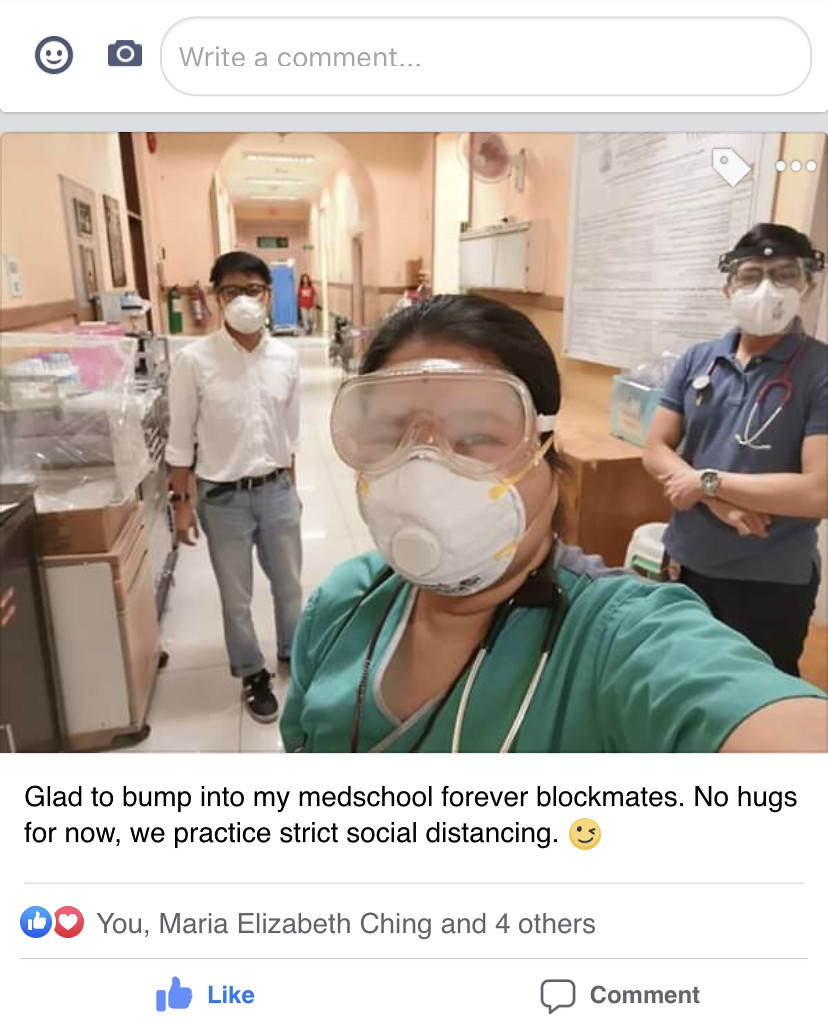
Saw Lennie and Carlos, block mates from med school on my last duty stint at PGH. Lennie C. is a neurologist, taking her fellowship in stroke. Carlos C. is a gastroenterologist, with special interest in bourbon, English shoes, and bespoke suits. I'm proud of them. (This is a screenshot of Lennie's Facebook post).
This was in March 29, after my last 24-hour stint at UP-PGH as a trainee. I've been out of the hospital, and of work, since then. I look forward to what the Lord has in store for me. Please pray for me as I seek His direction career-wise.
We've come full circle may well be the caption of this photo. My first clinical exposure was in LU3 (first year in medicine) at the Neurology ward (Ward 5), with Lennie, Ching, the Catangui twins, Jegar, Casti, Marv, Dalvie, and Joreb. I had no clue how to remember the spinothalamic tract! (Carlos belonged to the other half of the block; their preceptor asked easier questions!) It seems fitting that in my final day at PGH, I got to visit Ward 5 and was reunited with dear friends who, like me, are wiser and better physicians than when we had started out.
The Tales of Beadle and the Bard, J.K. Rowling
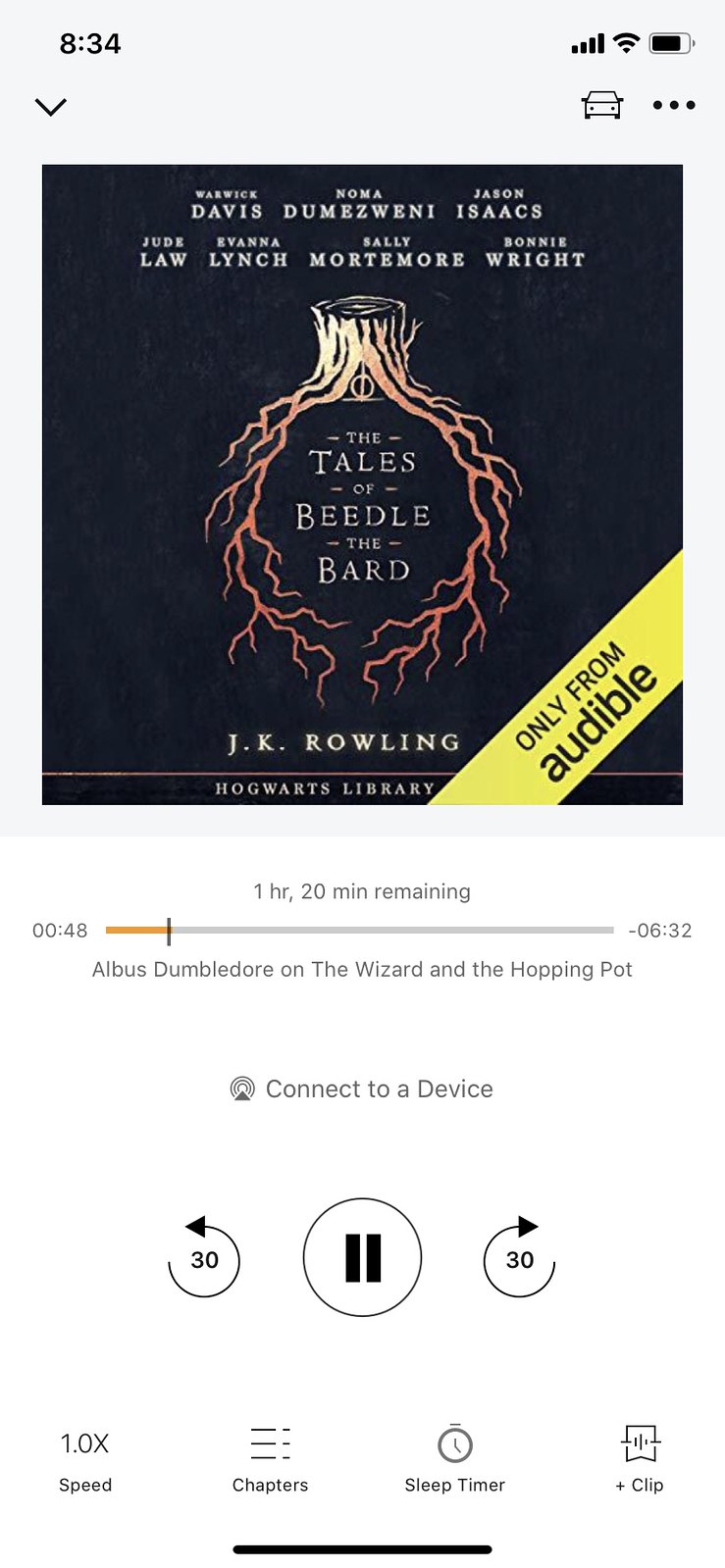
My friend and colleague Harold recommended this to me. Very fascinating. Best enjoyed a few minutes before sleep.

Lamy Safari and Russell Moore
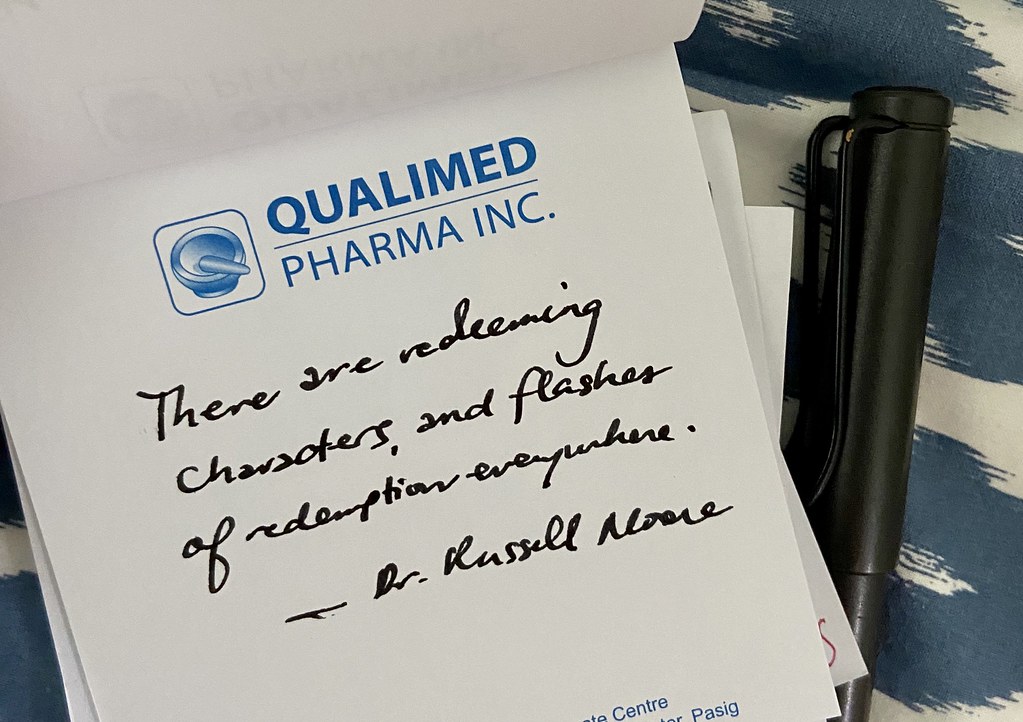
Can't remember where I read this line. I often write random words when I overhear a speech or read a line.

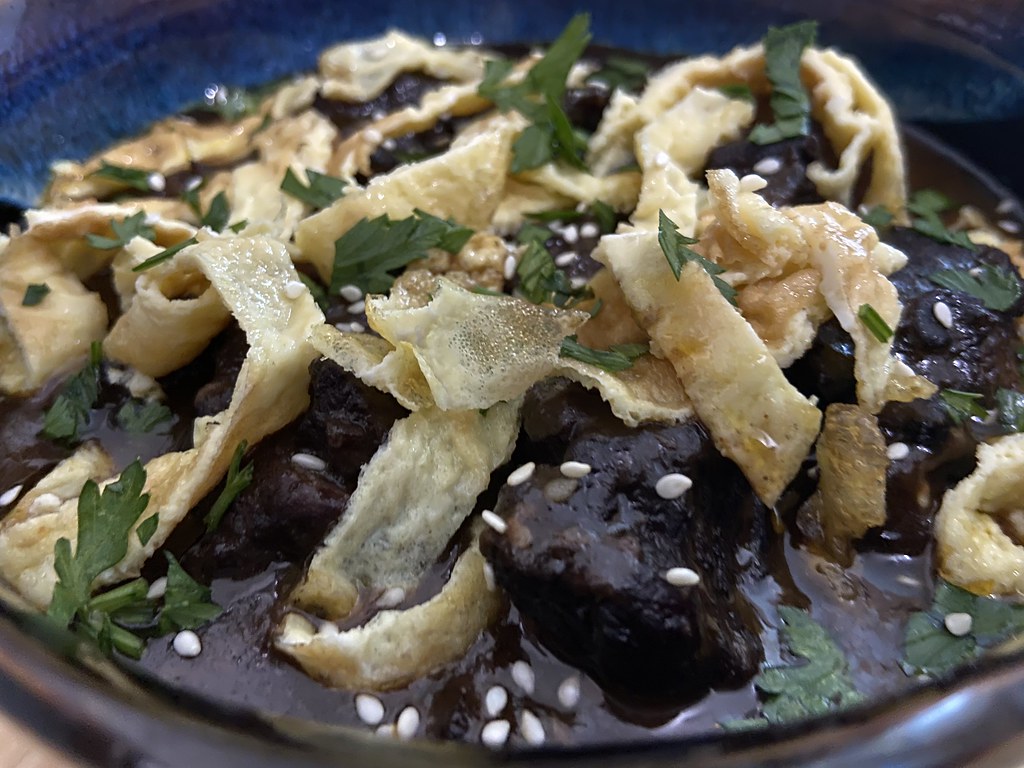
Unto the shore, the rock of Christ
Each time I read the news, I'm assailed by bad news. It takes a lot of commitment to see the world from a biblical perspective. Christ our Hope in Life and Death, a stirring modern hymn, spurs me to think about my sure hope--not in medical science, not in human government, not in familial relationships, not in my own abilities. But only in Christ, my Savior and Redeemer.
Unto the grave, what shall we sing?
“Christ, he lives; Christ, he lives!”
And what reward will heaven bring?
Everlasting life with him.
There we will rise to meet the Lord,
Then sin and death will be destroyed,
And we will feast in endless joy,
When Christ is ours forevermore.
Words and Music by Keith Getty, Matt Boswell, Jordan Kauflin, Matt Merker, Matt Papa
©2020 Getty Music Publishing (BMI) / Messenger Hymns (BMI) / Jordan Kauflin Music (BMI) / Matthew Merker Music (BMI) / Getty Music Hymns and Songs (ASCAP) / Love Your Enemies Publishing (ASCAP) / adm at MusicServices.org
From the YouTube channel:
"What is your only comfort in life and in death?” For centuries, believers have learned the Christian faith beginning with that question. It’s the first article in the Heidelberg Catechism of 1563. Why start there? Because death is our common fate. Unless Jesus returns first, we will all die. To find comfort in life, we must know how we can face death. Hope comes only in trusting the one who died to take the curse of death and who crushed the power of death by his resurrection. “Christ has been raised from the dead” (1 Cor 15:20). That is the only statement that can transform how we live each day and how we prepare for our earthly life to end.
Associate member of the PSMO

I was officially inducted as an associate member of the Philippine Society of Medical Oncology last night. The ceremony was prerecorded. The video clip began with our replies to the question, "What is the most important lesson you learned during this pandemic?" I gave a short but truthful reply, "I learned to trust in God alone." Others gave fascinating answers, most of them quotable soundbites. Fred gave the Korean heart sign at the end. Rich spoke about the politics of health. Karen alluded to the distance and nearness of human company. Roger talked about the "mess" of this Covid-19 crisis, the most exasperated version of him on camera. Kgel from the University of Santo Tomas threw in the word, "plasticity," clearly an offshoot of her readings in DeVita about the defining characteristics of cancer. Marge, also from UST, talked about valuing the things and people that matter the most. It amazed me how many new fellows were comfortable in front of the camera. Toni sounded like a morning show host! Congratulations to all the new associate members! I feel so honored to be counted in your company.

Pens in films: The Spirit of the Beehive
Watched The Spirit of the Beehive (El espíritu de la colmena) yesterday. You can watch it by following the instructions here. It's a quiet but disturbing film about childhood and imagination. What I found most interesting were the fountain pens. This was set during the time when fountain pens were commonplace.
Jessica Zafra writes:
Some screenshots of pens. If you can identify them, please let me know!

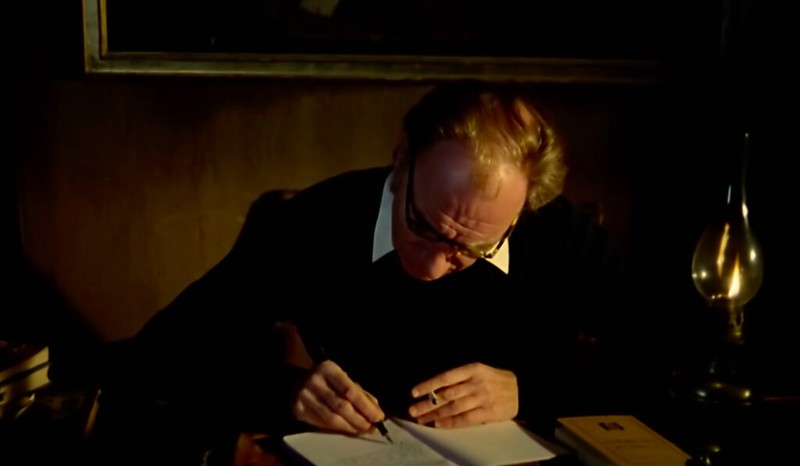
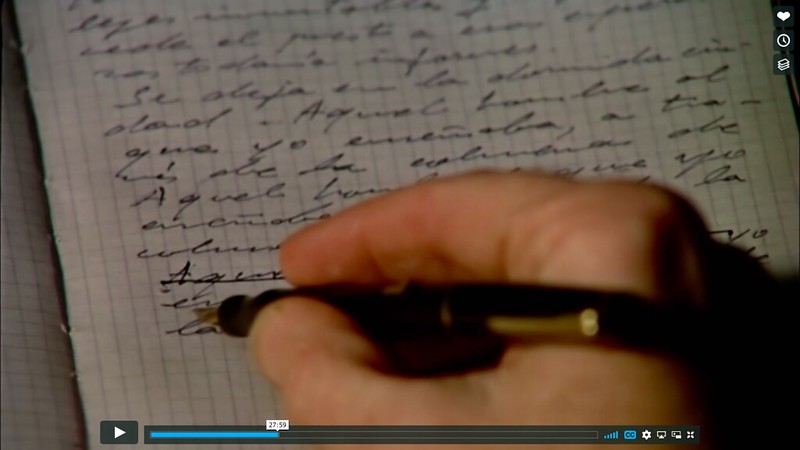
I should compile films with fountain pens in them!
Jessica Zafra writes:
The Spirit of the Beehive is set just after the end of the Spanish Civil War, and the house is paralyzed with sorrow, or fear, or both. Franco the dictator was still alive when the film came out, but maybe it was too enigmatic to incur the ire of the censors. Or else the censors counted on the audience not getting it. Today it is hailed as a masterpiece, its eerie quiet the appropriate soundtrack for a nation traumatized by war.
Some screenshots of pens. If you can identify them, please let me know!
I should compile films with fountain pens in them!