Sleepy

Sean, making coffee at 6 am, says, "It's 2-22-2022 today." He pours hot water onto the ground Kulaman coffee beans, nestled in white filter paper. Black water, fragrant and stimulating, drips into the Hario glass container, and stops when the level reaches 300 mL. The coffee is for me and Manong Ralph. This is our breakfast. We forgo morning meals to lose weight. Breakfast is easier to let go than, say, a scrumptious dinner.

Meanwhile, Paul snuggles on the white couch in the living room. He is forbidden—at least, he was, a few days ago, when his nails were pointed and could potentially damage the furniture. It is a cold morning; our dog does not want to wake up yet. Why is he so tired when he should already be up and out, demanding belly rubs and licking our feet to gain attention? Did he destroy Nanay's flowers last night? Did he chew the leaves off the most treasured plants in the garden? We will never know until Nanay makes her rounds in a few minutes. She will rebuke Paul then forgive him at the same time. 

Sean calls out to Paul, whose ears come alive. Sean feeds him a morsel of food. Paul runs toward him, waggling his tail. Sean leaves for work, and Paul returns to bed.

The Hiligaynon word for the day is tuyó, which means drowsiness.
Anticipation

Dahúm

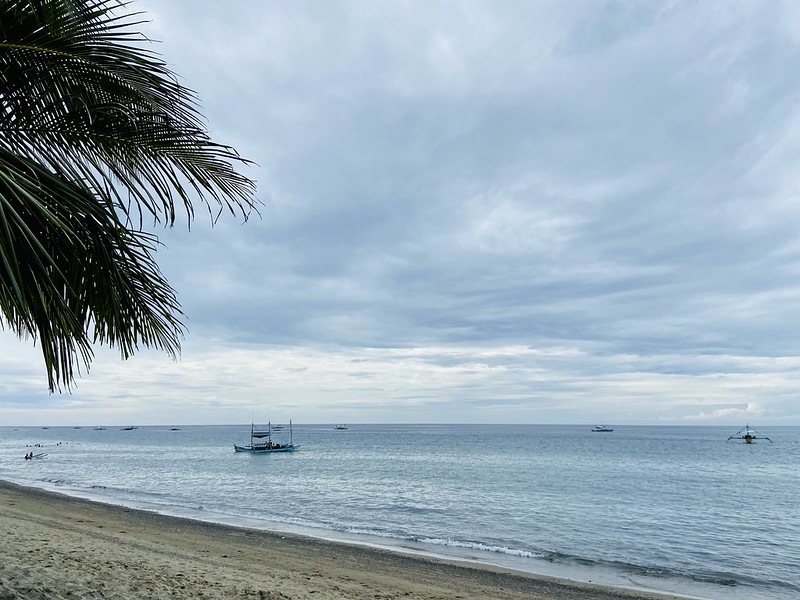
"Where do you want to go next month?" asks Auntie Bebet as we soak in the warm sea of Sarangani Bay, meters away from the coastline of Kitagas. The water is neck-deep. The waves are gentle. It is still early, by regular standards, but we are nearing the end of the narrow timeline that allows enjoyment without being sunburned. It is no small mercy to see thickening clouds from afar, showing incoming signs of rain, perhaps in a few hours: the perfect weather. As people of the tropics, we are tired of the sun and hide from it if we can.

We are in Kiamba, an hour's drive from General Santos (and two or three hours from Koronadal), for an end-of-the-month celebration. There is nothing specific to celebrate. The next birthdays are in February; the most recent birthdays have already been celebrated. There are no deaths or anniversaries, too. What has trigged this beach overnight escapade is my cousin Hannah's wish to visit the sea. Working in Manila for many years, she hasn't been to the beach in two years. We agreed, "Why not?" For my mother's side of the family, it is the most spontaneous plans that often push through. 

On the Friday night of our arrival, my cousins and I played Monopoly just before we slept. The youngest among us, Adrian, was the banker and fourth player. Speaking like an old, mature man when he is barely through with his teenage years, Adrian scolded his Kuya Kobe (his cousin many years older than him) for not paying attention to Vine Street, with a warning that he would lose the chance to collect rent if the next player had thrown the dice. Kobe, after four turns, eventually mortgaged his properties and ended up bankrupt—much to his relief, for he seems to have been pressured into joining the game in the first place.

We have all the beach to ourselves. A sister from church, who owns the property, has allowed us full access. It is not a big hotel but a charming private getaway that offers generous views of the mountains on the other side and the sea on the opposite. Her generosity inspires and encourages us. It is fascinating that God's economy operates beyond human logic: joy is multiplied when blessings are shared. It is what she lives by.

We are home now, safe in our landlocked properties and farms. As we return to the cares of this world—emails to check, patients to see, office work to accomplish—we hear the sea beckoning us to return during the lucid intervals of days. And we will, by God's grace. Maybe in February?

The Hiligaynon word for the day is dahúm. It means anticipation.

Dahúm
Ink: Pilot Iroshizuku (Bishamonte), 100th Centennial Edition. Read about how I got it in Singapore. Pen: TWSBI Eco White, rose gold, medium nib. Paper: Victoria journals

River

We had lunch at my aunt's farm in Banga, some 30 minutes away from Marbel. A tributary of the Banga River flows through this property. 

Banga River

When we were children, we would traverse the waters, but only when it was safe. The river could rise to dangerous levels during heavy rains. Our cousins told us of carabaos, farmers, and children drowning to their deaths. 

We visited this farm during summer breaks from school. Our slippers would be trapped in the fine, dark sand underneath, but losing our footwear and walking barefoot to Auntie Cecil's house was part of the fun. She had spare slippers waiting for us, with a warm meal of tinolang manok (free-range, "native" chicken), adobo and vegetables fresh from the garden. 

The Hiligaynon word for the day is subá. It means river.

subá (river)
Ink: Vinta Sea Kelp 1944. Pen: Platinum 3776 Chartres Blue, medium nib. Paper: Bazic Premium Composition Notebok, quadrille ruled.

New

I woke up to Paul's crying at 1 AM. I turned on the lights in the living room and, in my pajamas, went out to the garden to look for him. The night was dark but alive. I could hear fireworks and car horns from distant neighborhoods. I imagined families drinking beer with pulutan after a hearty salubong meal, enjoying the happy times, which, in the past years, have been few and far between.

Sean met me in the living room. Paul, tagging along with my brother, wagged his tail. I was surprised to see him in a playful mode; normally, by that time, he'd be curled up in the porch, relishing the coolness. He was in Sean's room all along, safe from the human noise and activity.

Nanay and Manong could not be bothered to wake up. Sean returned to bed, telling Paul, "Hindi magsinabad ha? Tulog na kita." Minutes later, I turned off the lights, went back to bed, and dreamt of an adventure I could no longer remember.

It is 2022. Praise be to God for His goodness and mercy. 

The Hiligaynon word for the day is bág'u. It means new.

Bàg’u (bago)
Ink: Diamine oxblood. Pen: Kaweco Student 70's Soul, medium nib. Paper: Muse Cahier d'Exercises (80 gsm, 5 mm dotted).

Hearkening back to an earlier time of self-expression and community

Tom Coates of PlasticBag.org on his excuses for not blogging, and his reasons for coming back after seven years of silence.
And hence the second answer to the question, why have I started again? Well, first up, I don’t know that I have. This could be the only new post I ever put up here. But if it is, it won’t be because I’m writing lots elsewhere. We live in a new time of isolation and fear. Twitter feels too urgent and anxious and tense right now. There’s no space to think or breathe. Facebook is filled with all the angst and pain and fury people are feeling. It’s overwhelming. Instagram is filled with people performing a perfect family lockdown experience interspersed with adverts for masks.

And suddenly, I find myself hearkening back to an earlier time of self-expression and community. The crowds have gone. There are no hordes of people waiting outside for a new post to emerge. There’s little to no pressure. Everyone’s not looking. It’s just the relics from an earlier era, posting periodically. And suddenly, maybe just for this one moment in time, that community is who I need. That community is who I miss. And talking to them in this kind of way feels right.

Spot on, especially the lines, "There's little to no pressure. Everyone's not looking. It's just relics from an earlier, era, posting periodically." I picture in my head stars from billions of light years ago, their light traversing the quiet universe, showing their presence only now. Do I make sense? 

My high school classmates were intrigued that I'm not active on social media. I told them I've discovered the joy of missing out. I should've added, "But I have a blog!" (which is hardly visited and read now, perhaps just the way I like it.)

Kabacan

Kabacan 2021

Spent the night in Kabacan, Cotabato Province (not "North" Cotabato, as I was corrected) to visit Kuya John's family. It's a university town whose heart is the University of Southern Mindanao. Students will return for limited in-person classes on January. When we passed through, we only saw gardeners, farmers, and security guards in campus. 

This is, I'm ashamed to admit, the first time I'm setting foot in North Cotabato. You'd think that North and South Cotabato (which decided to break off from the Cotabato Empire in 1966) would be beside each other, but they are not. 

It's no small grace to catch up with Kuya John, now based in Sydney, and Ate Gladys, their parents, and Ate Gladys' kids. 

Revisiting old haunts

With some free time for myself this Christmas season, I revisited blogs I used to subscribe to. These websites flourished in the days when the internet was kinder. Most of them are now dead or dying.

I was in college when I started blogging. The year was 2004. The place was an internet café past the parking lot of the UP Diliman Shopping Center. I did not own a personal computer. At 16 years old, I had many ideas. I wanted to tell the world about them. I was an English major, fresh out of high school from a quiet town most people in the big city never heard of. Realizing I could never start a newspaper column for national syndication, owning a small patch of land in the Web thrilled me. The design and coding, the posting, the linking to other websites fascinated me that I did them all for free. The process was the reward.

That seems like ages ago. This blog is now 17 years old—older than my inaanaks. I am now a doctor, more mature in my faith and thinking, more circumspect in my posts. I write this from my own laptop, connected to my own internet connection. I don't remember that last time I’d been to internet cafés. I suppose they, too, are things of the past.

Two days ago, I sent a link to my Christmas post to a colleague from the faculty. She asked me what Bottled Brain was. I said, “It’s my personal website. Nobody knows about it, except for close family and friends.” That remains true. I do not completely know what my personal blog is about. A workable definition is that it is an online journal where I write about my daily life, my meditations on God and Christianity, my books, my patient encounters, my fountain pens and inks, and many other things besides.

In 2021 I did not feel like writing at all, but force of habit kept me going. I pray I do better in 2022.

Jason Kottke wrote that the decline of the Blog should not be a cause for lament. But I grieve for the disappearance of my old haunts, in the same way I am saddened by the closure of a favorite restaurant or the burning down of an old building. Nevertheless, the old has gone—but not completely. And if you, dear Friend, have been dropping by my small patch of land in the vast, chaotic, noisy Web for the past years, I suppose you realize that, too. Blogging is not dead and will likely live on quietly, to give us joy and company for the years to come.