Sunday, January 25, 2026

The upright piano is installed

Untitled

I brought Nanay to a Japan surplus shop in Gensan last Friday, after work. She'd be picking oil paintings she had identified earlier. At home, she likes to put artworks on rotation. The paintings are nothing fancy or of real resale value; she likes color and landscapes and flowers without any idea of the hands that created them. The paintings were the reason for that visit. 

But I had an accidental, but providential, discovery. 

While waiting for her, I saw a couple of upright pianos on display. I asked the lady about them. "They've just been tuned, Sir," the lady said. "Feel free to play something."

So I did. My fingers were dusty, literally, from the playing. The Kawai looked abandoned and ignored, hidden by racks of Japanese cups and silverware. But I loved how the music sounded. 

I remember Auntie Netnet tell me about used pianos in the surplus shops three years ago. I ignored the advice and looked elsewhere. When wisdom prevailed, I realized I couldn't justify the cost of buying, say, a brand new Yamaha. I'm no concert pianist. I play in church. I play at home, mostly for fun and for meditation. Reading notes from the hymnal is an exercise in attention, like learning how to read the Distar textbooks in preschool. It keeps me away from my phone, and my mind and soul find clarity and silence in the music. 

"I think I'd like to buy it," I told the lady. 

The lady said, "Ask the owner for a discount."

I did. He gave me a huge one. He'd have the piano delivered on Saturday for a small fee. He said, "The piano is heavy, as you know. We'll have three people bring them to Marbel. But can you look for three or four strong men to help with the lifting. Maybe neighbors you can call to help? I'm sorry we're short in manpower."

Nanay had an idea: she summoned Uncles Malot and Boboy from Banga. Auntie Bebet was excited, too. Installing the old piano had become a family affair. 

I should have read and asked if the piano was any good. But I bought it on impulse. Nanay also approved: I could not bring any furniture at home without her approval. A query in ChatGPT revealed the following details: 

Kawai K-20 Upright — What You Have
  • Model: Kawai K-20
  • Type: Professional upright piano
  • Height: ~122 cm (48 inches)
  • Era: Typically late 1980s to 1990s
  • Build: Japan-made (earlier K-series were Japanese production)
  • Serial: A 781657 (fits with that general period)
What the K-20 is known for
  • Warm, clear Japanese tone (less bright than Yamaha, more rounded)
  • Responsive action, very suitable for classical practice
  • Solid build quality — these age well if maintained
A step above console/studio uprights; closer to an “institutional” upright
In Kawai’s old lineup, the K-20 sat above entry-level models and was often used in:
  • music schools
  • conservatory practice rooms
  • serious home pianists’ homes (emphasis mine!)
Maintenance notes (important at this age)

If it hasn’t been done recently, it really benefits from:
  • Regulation (action adjustment)
  • Voicing (tone shaping)
  • Annual or semi-annual tuning
When well-regulated, a K-20 can still feel beautifully alive even decades later.

Upright piano

Kawai upright piano
Kawai upright piano

I played This Is My Father's World. Paul, who prefers classical music, especially Beethoven, listened in rapture, contemplating the beauty of God's creation, perhaps—or was he tired from all the barking during the installation? Or was he criticizing my amateur playing?  

The warehouse is Gael Marketing, just along the highway. You'll be overwhelmed by the choices, but prepare to contend with the dust. Bring a face mask, if you have a lung condition.

(The piano reminds me of William Trevor's short story, The Piano Tuner's Wives, read by Yiyun Li in The New Yorker Fiction podcast). 

Labels: ,

Saturday, November 15, 2025

Wie lieblich sind deine Wohnungen, Herr Zebaoth

Morning walk with Paul

On mornings like this, as the sun rises to begin a new day, a heaviness weighs upon me. I squeeze a pillow under my blanket, then slowly leave my bed to turn off the air conditioning and make myself coffee. Paul lies on the living room floor, oblivious to my presence.

The tasks are many. I pray for strength to carry out the good work that God has set before me (Ephesians 2:10). When I turn on my cell phone, kept at bay in an empty room, I imagine a string of notifications, missed calls, and unread images. I let my phone be. I do not rush to it -- that bewildering machine that distracts and entertains -- but make time to grind the coffee beans and wait for the water to boil.

Dawn is my favorite time of the day. Full of possibilities and calm, it allows me to gather my thoughts. Gathering is necessary because my mind is a clutter, no matter what shelves I put up to compartmentalize and organize my thoughts. Friends know me as a morning person. I do my best thinking when everyone is asleep, and there is a cool freshness, albeit short-lived, around me. A few hours later, humidity and heat will prevail, but I will have been done with my prayer and meditation. 

Perhaps people in my profession are familiar with -- and have grown used to -- the weight of stories of pain and suffering. Perhaps this is the "good work" set before me today, one in which I can honor God through quiet compassion. I need God's strength to get me through the day. I need a perspective that sees past the cancerous tumors.  

Music helps. This morning I discover Johannes Brahms's  Wie lieblich sind deine Wohnungen, Herr Zebaoth. 


Wie lieblich sind deine Wohnungen,
Herr Zebaoth! 
Meine seele verlanget und sehnet sich
nach den Vorhöfen des Herrn;
mein Leib und Seele freuen sich
in dem lebendigen Gott.
Wohl denen, die in deinem Hause wohnen,
die loben dich immerdar. 

The English translation is: 

How amiable are thy tabernacles,
O Lord of hosts!
My soul longeth, yea, even fainteth
for the courts of the Lord:
my heart and my flesh crieth out
for the living God.
Blessed are they that dwell in thy house:
they will be still praising thee.  

  The song longs for heaven, where God dwells, and there is no more pain and suffering.

Labels: , ,

Sunday, May 18, 2025

My song is love unknown

I love hymns.

I love visiting churches with hymnals. I remember the hymnals as sweet-smelling maroon hardbacks aged by by overuse, with some pages detached and the spines torn. My grandmother’s Alliance church in Polomolok had those. During singing, the pastor would announce the song number; the congregation would flip the hymnal; the pianist would play the first two lines; then everyone sang.

It's not a stretch to claim that such formal liturgies have largely gone out of flavor. I’ve heard of churches that split up because half of the congregation did not approve of drums.

Many churches choose a more contemporary style of congregational singing, which is not wrong in itself. But I have a problem with shallow songs, with extremely repetitive lyrics, and hardly any reference to Scripture. Alistair Begg wrote about this phenomenon: 
H]ear our loss of focus on the gospel in our songs. This is no comment on musical styles and tastes, but simply an observation about the lyrical content of much that is being sung in churches today. In many cases, congregations unwittingly have begun to sing about themselves and how they are feeling rather than about God and His glory.
Songs are vital in the believer’s life. My hero, John Calvin, wrote: 
Now among the other things which are proper for recreating man and giving him pleasure, music is either the first, or one of the principal; and it is necessary for us to think that it is a gift of God deputed for that use. Moreover, because of this, we ought to be the more careful not to abuse it, for fear of soiling and contaminating it, converting [it to] our condemnation, where it was dedicated to our profit and use. If there were no other consideration than this alone, it ought indeed to move us to moderate the use of music, to make it serve all honest things; and that it should not give occasion for our giving free rein to dissolution, or making ourselves effeminate in disordered delights, and that it should not become the instrument of lasciviousness nor of any shamelessness…

And in fact, we find by experience that it has a sacred and almost incredible power to move hearts in one way or another….

What is there now to do? It is to have songs not only honest, but also holy, which will be like spurs to incite us to pray to and praise God, and to meditate upon his works in order to love, fear, honor and glorify him.

As for the rest, it is necessary to remember that which St. Paul hath said, the spiritual songs cannot be well sung save from the heart.…For a linnet, a nightingale, a parrot may sing well; but it will be without understanding. But the unique gift of man is to sing knowing that which he sings. After the intelligence must follow the heart and the affection, a thing which is unable to be except if we have the hymn imprinted on our memory, in order never to cease from singing. For these reasons this present book, even for this cause, besides the rest which has been said, ought to be singular recommendation to each one who desires to enjoy himself honestly and according to God…

I consider myself blessed to grow up with hymns—not exclusively, though. The local churches I’ve joined played a mix of contemporary Christian songs and classic hymns, both beautifully played.

The songs in church—whether they're classic and modern hymns or contemporary songs by, say Don Moen or City Alight—connect me to God. They lift my spirit and calm my soul. They nourish my mind and bring joy to my heart.

Since last year I've been taking piano lessons, precisely because I want to play hymns. I have no ambition of doing a Rachmaninoff concert, but I should at least develop enough skill to play songs in the hymnal. My piano teacher Ma’am Deb told me I could get a hymnal in the local Christian bookstore but the stocks were empty that I had to order through Amazon. Hymns of the Christian life, albeit a secondhand copy, is one of my favorite books.


PC250025

I’m on hiatus, piano-wise. My Monday lessons have to take the backseat for now. Ma’am Deb seems busy, too. But as soon as we resume, I’d love to learn My Song Is Love Unknown (1664), a hymn by Samuel Crossman. I first heard it sung when I streamed Redeemer Downtown’s Maundy Thursday service in Youtube (the song starts at 25:29 time mark).
My song is love unknown,
my Saviour’s love to me;
love to the loveless shown,
That they might lovely be.
O who am I,
that for my sake
my Lord should take
frail flesh and die?

He came from his blest throne
salvation to bestow;
but men made strange, and none
the longed-for Christ would know.
But O, my Friend,
my Friend indeed,
who at my need
his life did spend!

Sometimes they strew His way,
and His sweet praises sing;
resounding all the day
hosannas to their King.
Then 'Crucify!'
is all their breath,
and for His death
they thirst and cry.

Why, what hath my Lord done?
What makes this rage and spite?
He made the lame to run,
he gave the blind their sight.
Sweet injuries!
yet they at these
themselves displease,
and 'gainst him rise.

They rise, and needs will have
my dear Lord made away;
a murderer they save,
the Prince of Life they slay.
Yet cheerful He
to suffering goes,
that He His foes
from thence might free.

In life no house, no home
my Lord on earth might have;
in death no friendly tomb
but what a stranger gave.
What may I say?
Heav'n was his home;
but mine the tomb
wherein he lay.

Here might I stay and sing:
no story so divine;
never was love, dear King,
never was grief like Thine!
This is my Friend,
in Whose sweet praise
I all my days
could gladly spend.


My Song is Love Unknown

Labels: ,

Monday, October 28, 2024

A Chopin discovery!

As someone who's just beginning to play the piano, this news of discovering another Chopin composition is thrilling to me. I'm troubled when people say they like classical music because it's relaxing. There's some truth to it. Perhaps such people have only listened to some version of classical music which can be described as soporifics, the kind of sounds one can listen to before a restful sleep. These are the portions that also tend to be the more popular ones. But, to me, the best parts of classical music are the difficult parts, which stimulate and captivate and even trouble me. I am in awe of the difficulty of those pieces.  

I can only dream of playing something like a Chopin waltz one day, but I'm just happy I can read notes a little bit faster now and can play some church hymns, albeit with some difficulty. The piece I'm currently practicing on is Holy, Holy, Holy composed by Reginald Heber (1826) and appears in my second-hand copy of Hymns for the Christian Life. 

Read the entire article and listen to the Chopin waltz played by Lang Lang here.

Labels: ,

Monday, October 7, 2024

Lake Street Dive!

I discovered Lake Street Dive through their interview with David Remnick in the New Yorker Radio Hour. I'm a huge fan. My favorites: Hypotheticals, and Shame, Shame, Shame.  They have such great song titles! Their songs make me so happy that I listen to them early in the morning on my way to work, or after-lunch commuting, or late night drives back home. 


I’ve been playing out a lot of hypotheticals in my mind
I’ve been writing your name down next to mine
Been imagining all the things you and I could do oo oo


I’ve seen all the possibilities in my dreams
You’re alone when you should really be next to me
Baby, let’s not wait and see

I played the song to my mother, who said, "Nami man. Pero daw kabudlay kantahon."

Labels:

Friday, May 17, 2024

On Perfect Days

Perfect Days

Who else has seen Perfect Days? It's about a middle-aged man, Hirayama, who lives his every day. He wakes up early and hears the street sweeper outside. He rolls his mat, brushes his teeth, trims his beard, waters his plants, gets instant coffee from a vending machine, plays a song on a cassette tape, and drives to work. He is a toilet cleaner in what looks like an upscale neighborhood in Tokyo. He has lunch in a park where he takes photos with a film camera. He looks up at the sky and trees and smiles. After work he goes to an onsen and eats in an izakaya, where he has a glass of beer. He goes home, turns on the reading light, and reads a book before he finally falls asleep.

Nothing much happens. Hirayama hardly ever speaks. There's not a lot of dialogue. Other than the wonderful American songs in he plays in the car, the sounds you hear in the movie are mostly background noises, like vehicles swooshing, the toilet doors opening, or the leaves rustling.

I can't quite explain why I like Wim Wenders's film so much. Is it because I am in that moment in my life when I live almost the same way—getting through the day but finding quiet moments in between? Is it because the film is set in Japan, which has recently become one of my favorite places to visit in the world? Is it because the film seems free from distraction and celebrates the analog in an increasingly digital milieu? Is it because the ending features Hirayama listening to music and tearing up, like it was catharsis and thanksgiving in equal measure, and I often do the same, with prayer and remembering, because work can feel heavy? Is it because it is quiet and contemplative—and freedom from noise is what we all need at this point? 

I suppose all of those reasons are true. 

Image credit: IMDB.

Labels:

Friday, March 8, 2024

Psalter

Soon, if I improve my piano skills with more lessons and more practice, I'll be able to play the songs in The Genevan Psalter, compiled by Michael E. Owens.  The metrical psalter (also called The Huguenot Psalter) was originally created under the supervision of John Calvin. If you know me, you probably know I'm a huge fan of this Reformed hero. The Institutes of the Christian Religion is one of my favorite books of all time. I read the book in Kindle, during my long, humid, sweaty MRT commutes to the Philippine General Hospital from Mandaluyong.

The melodies were all composed between 1539 and 1562 in Geneva, Switzerland, at the request of John Calvin, for use with French metrical translations. No melodies have been added or removed since that time. Many have appeared in several forms, often rhythmically altered. They have been harmonized many times, in many ways, and have been often used without harmony. They have been sung with many different lyrics in several languages. Until the mid-1800s, they were widely used on the continent of Europe, the British Isles, and the New World. They are still used in some churches in Canada and Europe and Australia.

Currently, I'm working my way through Beethoven's Moonlight Sonata (first movement). Ma'am Deb gave me two hymns to practice on: Holy Holy Holy and It Is Well With My Soul.

Rediscovering music has led me to appreciate all kinds of music. I'm now subscribed to the amazing podcast, The Open Ears Project, "in which people share the classical track that means the most to them and why." I particularly liked the episode in which musician Damien Sneed "reflects on how playing Liszt’s Étude No 3, 'Un Sospiro,' for both his biological and adoptive mothers allowed him to finally loosen his grip around ideas of adoption, rejection and acceptance."

Labels:

Friday, February 23, 2024

Piano and teaching

One of my favorite blogs is owned by the writer and professor, Alan Jacobs. As a teacher myself, I learn so much from him. On the first day of his Christian Renaissance of the Twentieth Century course, he played for his students "a few minutes of the first movement of Rachmaninoff’s Second Piano Concerto."

He writes:
So one of the things I am doing in this class, and will be trying in other classes, is to get my students to spend five minutes listening to music. I forbid digital devices in my classes, so they just have their books and notebooks in front of them — they can of course be distracted from the music, but it’s not automatic, not easy. If listening is the path of least resistance, then maybe they’ll listen. I’ve started with five minutes, but I hope to work our way up to longer pieces. My dream — and alas, it is but a dream — is, one Holy Week, to sit together with my students and listen to the single 70-minute movement that is Arvo Pärt’s Passio.

This fascinates me. Playing music in class. I remember my neurology professor, Dr. Leonard Pascual, telling stories about playing the piano at the BSLR, the entire med school class jamming in songs. The BSLR was demolished a few years ago. Whatever happened to the old upright piano? 

I'm barely able to play the piano for myself—let alone for an audience. Each week, I carve a special hour for lessons with Ma'am Deb, my gracious teacher. My current piece is Beethoven's Moonlight Sonata. Maybe I can find a way to squeeze the piece in my introduction to my lectures of gene transcription.

Labels:

Saturday, January 13, 2024

"Ambition was utterly conventional"

I thoroughly enjoyed Sam Fragoso's interview with New Yorker editor David Remnick. I listened to it yesterday during my drive to work. I was so glued to it that I stayed inside the car for a couple more minutes to finish the episode. 

I'm a huge fan of David Remnicks' writing. In 2018, I bought his  book on Muhammad Ali after my arduous pre-residency at PGH Internal Medicine. I listen to episodes of New Yorker Radio Hour, one of my favorite podcasts, which he hosts. (I use Apple Podcasts, which is terrific, but according to friends, you can tune in to Spotify, too, which is just as great.)

But Sam's interview with David was the first time I heard about the esteemed editor's personal life. I was so interested to hear him speak about his awareness that, as the older of two brothers, he would be taking care of his parents. His father was a dentist who would later suffer from Parkinson's; his mother was an art teacher who would have multiple sclerosis. He never doubted of his parents' love. He said that in his family of immigrants, "Ambition was utterly conventional." His parents wanted him to be a good boy and to do good for himself.

"They [his parents] are your children now," he said, relating to Sam the role he took on to care for his family. He also spoke about his daughter who had "profound autism."

I love how he describes his fanaticism for Bob Dylan as "six miles past embarrassment." He talks about the situation in Gaza. (Hours after listening to the interview, I received a text from my brother that my copies of the New Yorker magazine arrived in the mail. One of the three copies was the November 6 issue, which features David's article, In The Cities of Killing.)

Sam is a terrific interviewer. David is a brilliant man. Here are the show notes from Talk Easy, where the interview originally aired. Do listen.

In the cities of killing by David Remnick

Labels: ,

Sunday, January 29, 2023

Lovingkindness

I praise God for Matt Redman, Matt Boswell, and Matt Papa—all Matts!—for composing this joyful anthem about God's lovingkindness! A blessed Sunday, dear friends. 

Let praises now awake the dawn
We’ll greet Your mercy with a song 
Your people stand and sing for all Your lovingkindness 
You’ve carried us in faithfulness 
Upon the paths of righteousness 
Our gracious King 
You’ve crowned us with Your lovingkindness

Labels:

Friday, December 30, 2022

Audrey Assad's music


Audrey Assad's Spirit of the Living God is in my head these days. It's one of the best music I've heard this year. The modern hymn is a prayer to God that is filled with expectation, faith, and hope. I love how the music illustrates the dynamics of Godhead: three Persons in one God. 
O Spirit of the living God,
thou Light and Fire Divine
Descend upon Thy Church once more
and make it truly Thine
Fill it with love and joy and power,
with righteousness and peace
Till Christ shall dwell in human hearts,
and sin and sorrow cease.

Blow, wind of God,
with wisdom blow until our minds are free
From mists of error, clouds of doubt,
which blind our eyes to Thee
Burn, winged fire,
inspire our lips with flaming love and zeal
To preach to all Thy great good news,
God’s glorious commonweal.

So shall we know the power of Christ,
who came this world to save
So shall we rise with Him
to life which soars beyond the grave
And earth shall win true holiness
which makes Thy children whole
Till, perfected by Thee,
we reach creation’s glorious goal
I'm much grateful to The Advent Project of Biola University for introducing me to painters, poets, and musicians. The last entry is on December 31. The artful meditations have been so refreshing to my soul. I'll be sure to subscribe to similar meditations next year.

Keep Reading

Labels:

Tuesday, December 27, 2022

Sing we the song of Emmanuel


This is Keith and Kristyn Getty, Matt Boswell, Matt Papa's Sing We the Song of Emmanuel, a joyful, expectant, theologically-infused hymn played on loop in our home. Enjoy!

Sing we the song of Emmanuel
This the Christ who was long foretold 
Lo in the shadows of Bethlehem 
Promise of dawn now our eyes behold. 
God Most High in a manger laid 
Lift your voices and now proclaim 
Great and glorious, 
Love has come to us 
Join now with the hosts of heaven

Labels: ,

Sunday, December 25, 2022

We crave for Your return

We continued our Christmas Eve tradition of sleeping early and waking up fresh to a new day. Later today, after Sunday worship service, we are hosting our mother's side of the family at home. The cakes are baked, the food prepared, and tables set. In the midst of the preparations, Scotty Smith's prayer for December 24 is an example of how we can be more heavenward in our celebrations.

Lord Jesus…

As the Last Adam, you obeyed and fulfilled the law for us.

As the Lamb of God, you bore our sin, and took our judgment.

As the Grave Robber, you conquered death and arose to give us life.

As the Lord of Lords, you are sovereign over kings, people, and places.

As our Great High Priest, you advocate, care, and pray for us constantly.

As our Loving Bridegroom, you are coming back for us with great delight.

As the Grace Giver, you take on “the hopes and fears of all the years” (ours too).


Hallelujah, and thank you. Jesus, as you lavish your love on us, we cast our cares on you. We worship you, Jesus. We need you. We crave your return. So Very Amen.

Labels: ,

Monday, May 10, 2021

Shtisel, my new favorite show of all time—among a few others

Not exaggerating when I say Shtisel is simply one of the best shows I've seen in my life. It ranks alongside Breaking Bad, Veep, The Office (US), Derry Girls, and The Mandalorian.

“Shtisel” is generous, lighthearted, and nostalgic—even when the origins of its nostalgia remain elusive. It is also a little old-fashioned, not only because of its subject matter but because of its situational structure. Things happen and cease to happen to the characters within a single episode: an illness, a robbery. It’s drama dressed as a sitcom. The show’s center of gravity is the father-son relationship between Shulem and Akiva, who are usually seen sitting around their cramped kitchen table, with its waxy tablecloth, eating sliced vegetables in their shirtsleeves and prayer shawls.
Love the characters. So fascinated by them that I find myself reciting Old Testament verses as they pray. Enjoyment is cloaked by sadness—these people reject Jesus Christ. While Christians are awaiting the Lord's second coming, they are still expectant for the first coming of the Messiah. While Christians believe that salvation is by God's grace through faith in Jesus, they believe that they must obey the law to the letter in order to be saved.

Still—the series displays so much humanity in a secluded, ultra-religious community we almost know nothing about. 

Brothers to me: "Watching Shitsel again?"

"Not Shitsel. SHTIsel!" 

Labels: ,

Saturday, December 26, 2020

Smiley's People

Untitled

Alec Guinness, Smiley's People -- screenshot 

When I should have been studying, I have been watching SMILEY'S PEOPLE, an old BBC series based on the novel of John Le Carré. George Smiley is played by Mr. Alec Guinness. Mr. Guinness is spectacular in this role! He is serious, methodical, and unemotional. I love his pair of thick-rimmed spectacles. I have a similar pair.

Labels: ,

Thursday, October 15, 2020

From North to South

Starved for adventure, I'm watching "Long Way Up" on Apple TV+.
Starring and executive produced by Ewan McGregor and Charley Boorman, “Long Way Up” reunites the best friends after more than a decade since their last motorbike adventure around the world.

Covering 13,000 miles over 100 days through 16 border crossings and 13 countries, starting from the city of Ushuaia at the tip of South America, Ewan and Charley journey through the glorious and underexposed landscapes of South and Central America in their most challenging expedition to date, using cutting-edge technology on the backs of their prototype electric Harley-Davidsons in order to contribute to the sustainability of the planet.

What I most like about it is that it's fun to see friends hanging out, minding their own business, discovering the world. The views are spectacular.

Labels:

Sunday, September 6, 2020

Evensong

Listening to Evensong: A Collection of Hymns and Lullabies at Close of Day, the newest album of Keith and Kristy Getty. 

Kristyn Getty says, “These are lullabies and hymns we have sung to and for our four daughters. Singing God’s truth into both the more quiet and vulnerable moments of the day has been a centerpiece of raising our own kids. I know I need true words spoken into my heart and mind to help de-clutter all that presses in upon me from day to day. I hope these songs help people dwell on the Lord and His promises; to release a burdened mind, to calm a restless heart and point us towards real peace in Christ.”

“The Bible has long encouraged believers through the ages to sanctify the night to the Lord,” Keith Getty says. “And the church’s ancient tradition called “evensong” is for spending time before the Lord in prayers and songs at the end of the day. The album is in some ways an echo of that tradition; the songs and the album were born out of the thoughts and conversations, the prayers and songs that fill our home, particularly when the sun goes down.”

Praise be to God for these modern-day Psalmists! You can stream the songs in these channels. 

Labels:

Tuesday, August 4, 2020

I think it's going to rain today


Current LSS: Audra McDonald's I Think It's Going to Rain Today. She's right on two counts. First, kindness is overflowing, despite humanity's depraved nature. Second, I think it's going to rain today.

Broken windows and empty hallways
A pale dead moon in the sky streaked with gray
Human kindness is overflowing
And I think it's going to rain today

Scarecrows dressed in the latest styles
With frozen smiles to chase love away
Human kindness is overflowing
And I think it's going to rain today

Lonely, lonely
Tin can at my feet
Think I'll kick it down the street
That's the way to treat a friend

Bright before me the signs implore me
To help the needy and show them the way
Human kindness is overflowing
And I think it's going to rain today

Labels:

Thursday, July 16, 2020

Friends and Korean shows

Many people I know are rabid Korean film fans. Even my mother watches Korean shows—this, after watching all the American and British shows in Netflix. Detached from the outside world, holed up inside her room for most of the day, she recommends to me what shows I should watch next. She recommended Yong-pal and My Country to me. Hannah, Uncle Toto’s eldest daughter who lived with us when she went to school in Marbel, recommended Goblin. I watched these shows with a steady fascination and a kind of detached cluelessness.

Yong-pal is about a surgeon who tends to injured gangsters in secret, so he can pay off his debts. My Country: The New Age, a period film, is about two friends—I never got past the second episode. To my mother’s disappointment, I watched Kingdom Season 2 instead. It is about a raging pandemic spreading across ancient Korea. “What pleasure do you derive from watching those zombies?” my mother asked. “These zombies are the fastest runners I’ve seen!” I said.

Goblin is about two otherworldly individuals. As ghosts who possess extraordinary powers, they meddle with the living. I never got past the fourth episode. The story line was too cheesy for me, but Hannah adores it. In the arena of drama and love stories, I still prefer Descendants of the Sun, a story about a soldier and a doctor who meet during a war-time medical mission. It took me a while to realize that Koreans are fascinated with doctors, hospitals, and tycoons. There’s bound to be a powerful man referred to as “chairman” or “director.” A more serious drama I liked is Misty—I don’t know why that’s the title. Misty is about an ambitious journalist who, for her career, sacrifices her marriage but never her principles. She once married her husband—a rich, well-connected lawyer—to leverage her ambitions. Her husband loves her unconditionally. She falls in love with him years after they'd been together.

Clearly, this is the golden age of Korean cinema. My friend Chevs, a doctor based in the States, pointed out that this so-called golden age may have begun since our college years (circa 2000). I remember that, as freshmen in Kalayaan, the Basement Boys gathered inside Luther’s room to watch a pirated DVD of My Sassy Girl. Chevs recommended Reply 1988, which is about friends who grow up in the same neighborhood during the time when Seoul hosted the summer Olympics. Nothing much happens in it, but I enjoy watching an episode a week for the nostalgia. Those were simpler—and arguably, happier—times.

This fascination for Korean films must be so pervasive that even one of my father’s closest friends, Tito Bong, mentioned that he watches those shows in Netflix. Kuya John, based in Sydney and who celebrated his birthday this week, recommends It’s Okay Not To Be Okay, about a morbid children’s book author who meets a caregiver. It may well be a commentary on mental health, brotherly love, and so on, but what appeal to me the most are the graphic designs. Like me, Kuya John also watched The King: Eternal Monarch as each episode was rolled out weekly. Don't confuse this with Kingdom since it is not about zombies but about parallel worlds: the Republic of Korea and the Kingdom of Corea. There’s a love angle in it. The king meets a clumsy police officer. They kiss and embrace while snow is falling in slow motion. It took me a while to realize, too, that Korean shows like flashbacks and slow motions, usually with snow or falling leaves, with heart-wrenching pop music in the background, highlighting a limited string of English lyrics in the chorus.

Of all the genres, I love the Korean political shows most of all. I think Korean shows particularly excel when they are serious. I also don’t get Korean humor. I rewatch episodes of Designated Survivor: 60 Days. It begins with the bombing of the Korean seat of parliament, killing all the top government officials. As mandated by the constitution, the environment minister—a lowly scientist—is next in line to succeed as president. He grapples with a broken nation and political opposition. With integrity, love for country, and well fitted suits, he rises to the office and stirs the nation forward. I love Chief of Staff, too. It’s about an ambitious man who climbs his way to the top to become an assemblyman. To achieve the greater good, he compromises, strikes deals with seedy politicians, but he stands by his general principles. You may disagree with his methods but not his intentions. The protagonist, Jang Tae-Jun, uses a fountain pen once owned by a late friend and mentor. The fountain pen is a constant reminder for Jang Tae-Jun to honor his friend’s memory: by standing up for the poor and oppressed. These political dramas are good for the soul. They remind us that goodness prevails in the end. Good leadership seems like a rare commodity during these times.

Labels: ,

Sunday, July 12, 2020

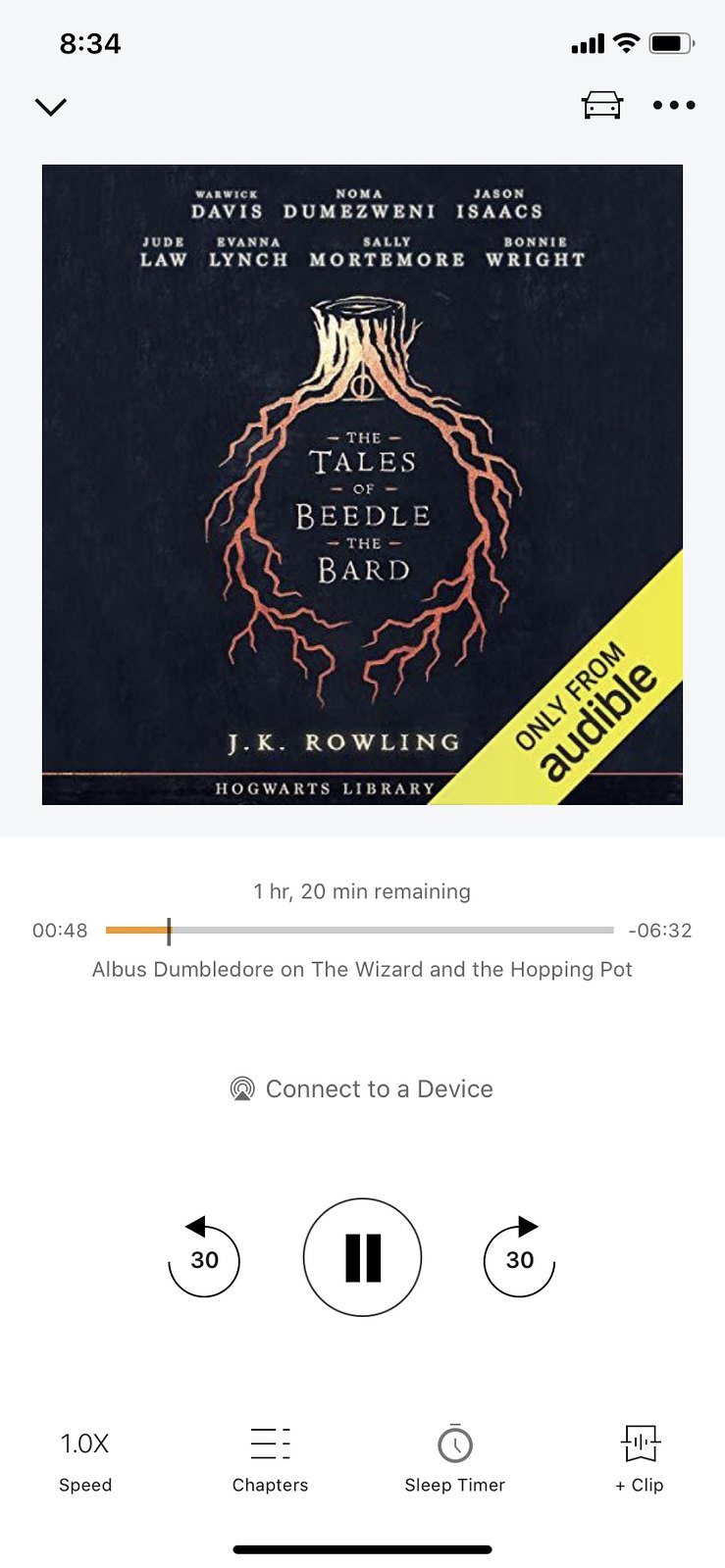
The Tales of Beadle and the Bard, J.K. Rowling

Lockdown Audiobook

My friend and colleague Harold recommended this to me. Very fascinating. Best enjoyed a few minutes before sleep.

Labels: ,